

The currency adjustment factor (CAF) is a carrier surcharge that accounts for currency fluctuations affecting vessel operating expenses. Carriers bill CAF either as an additional charge above base ocean freight or as part of a combined rate. Currency shifts directly alter landed shipping costs. Quotations must state whether CAF is included, which charge base applies, and when the rate takes effect. Reviewing these calculation mechanics helps importers evaluate freight proposals, verify surcharge rules, and prevent billing surprises before booking cargo.
What Is the Currency Adjustment Factor in Shipping?
In ocean shipping, the currency adjustment factor (CAF) is a carrier surcharge rather than a customs duty, port tax, or foreign exchange fee. Carriers assess this charge to manage currency risk when operating expenses and freight revenues involve different currencies.
The Purpose of Currency Adjustment Charges
A shipping line often collects freight revenue in US Dollars while paying bunkering, port terminal fees, and canal dues in local currencies. If the revenue currency weakens against an operating currency, covering the same operating expense requires more revenue currency.
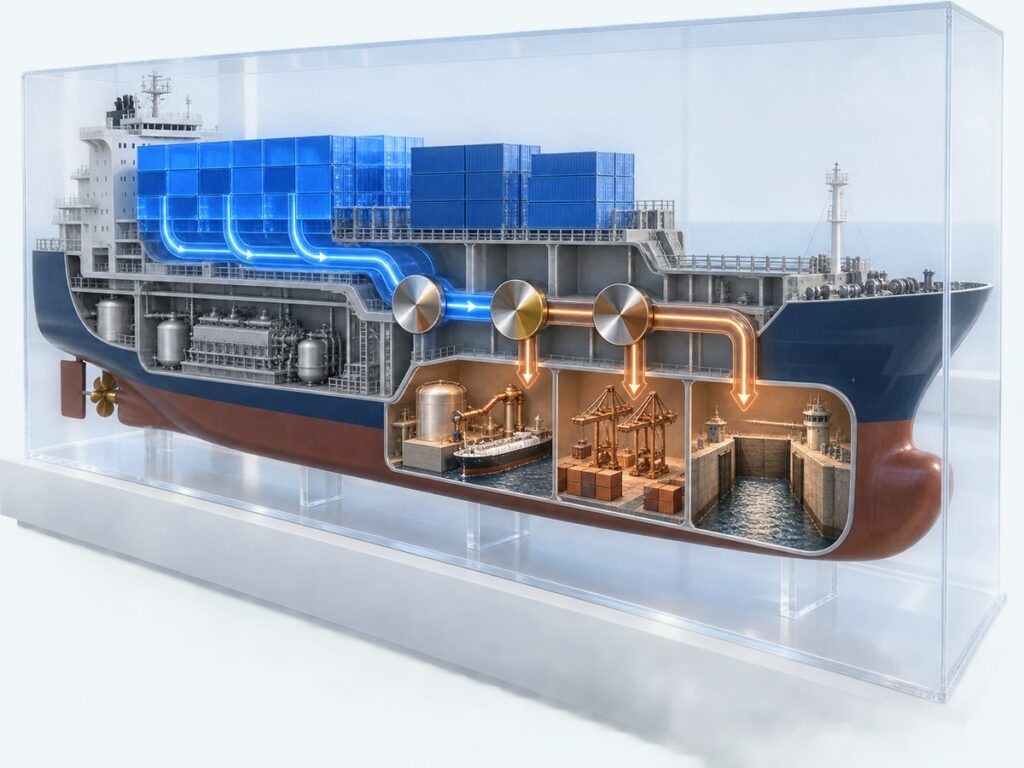
Carriers apply CAF to balance this currency exposure according to their tariff rules. The surcharge typically increases freight bills when operating currencies strengthen against the billing currency. Downward adjustments or credits occur only if the carrier tariff explicitly allows them. Paying an invoice in the quoted currency does not eliminate CAF. The underlying currency exposure belongs to the carrier rather than the shipper.
CAF Application Across Carriers and Trade Lanes
Carriers establish distinct CAF levels across different trade lanes, origins, destinations, and sailing directions. Carrier surcharge notices frequently specify different percentages for inbound and outbound voyages, tying rate validity to a vessel sailing date. Importers must examine both the trade lane and the governing effective-date rule when reviewing quotes.
When booking ocean freight services, shippers must verify how surcharges apply to specific cargo modes. For example, shippers cannot apply a published full-container (FCL) percentage to less-than-container-load (LCL) cargo without confirming the forwarder’s consolidation terms.
How Is the Currency Adjustment Factor Calculated?
Calculating a percentage-based CAF involves multiplying the approved charge base by the published surcharge percentage. Setting that percentage is an internal carrier calculation, meaning shippers cannot calculate CAF by simply tracking daily foreign exchange market shifts.
Carrier Methods for Setting CAF Rates
Carrier pricing teams evaluate a currency basket reflecting where vessels operate and incur expenses. Because carriers assign specific weights to each cost currency, the resulting CAF percentage rarely matches the fluctuation of any single currency pair.
Shippers should separate carrier rate-setting formulas from actual shipment billing calculations. Setting the surcharge requires carrier index methodology, while calculating the freight bill requires only the confirmed rate and the agreed charge base.
If a quotation states that CAF fluctuates, request the governing tariff or surcharge schedule. A complete schedule identifies the basket currencies, review intervals, effective dates, and trigger thresholds. Without these details, shippers cannot audit the adjustment against market exchange rates.
Applicable CAF Rates and Charge Bases
For percentage-based quotations, calculate the fee using this standard formula:
CAF amount = Eligible freight amount × (CAF percentage ÷ 100)
The eligible freight amount covers only the specific charges designated in the tariff. Unless explicitly stated, it excludes terminal handling fees, origin documentation, inland trucking, and other accessorial charges.

When carriers quote CAF as a fixed monetary rate per charging unit, calculate the fee using that designated unit. Check whether the charge applies per container, per twenty-foot equivalent unit (TEU), per revenue ton, or per bill of lading. Comparing percentages alone can mislead buyers. A lower percentage applied to an inflated base often produces a higher dollar charge than a higher rate on freight alone.
A Worked CAF Calculation Example
Consider a quotation for a 40-foot container with the following line items:
- Base ocean freight: USD 2,000
- CAF: 5% applied strictly to base ocean freight
- Origin and destination charges: USD 300 (excluded from the CAF base)
The billing calculation proceeds as follows:
- CAF surcharge: USD 2,000 × 5% = USD 100
- Quoted total: USD 2,000 + USD 100 + USD 300 = USD 2,400
Applying 5% incorrectly to the full USD 2,300 subtotal produces USD 115, overbilling the shipment by USD 15. This calculation illustrates surcharge mechanics rather than current market pricing. The total reflects only named items, leaving unlisted accessorials outside the agreed figure.
How Does CAF Affect Ocean Freight Quotes?
CAF is one part of total freight forwarder cost, and it directly alters the payable invoice when billed separately. Surcharge inclusion status and validity windows can affect landed costs as much as the quoted freight rate.
Separate Charges and Included CAF
Quotations present CAF either as a distinct itemized line or integrated into an all-in freight rate. If an agreement already incorporates currency adjustments into the base rate, billing CAF as a separate line item creates duplicate charges.
An all-in label does not automatically guarantee fixed costs. Importers must verify whether the rate locks CAF through cargo departure. A similar principle applies to door-to-door shipping: comprehensive routing does not automatically absorb every carrier surcharge or local port expense. Experienced forwarders like Foresmart itemize origin handling, ocean transit, and destination clearance. This breakdown clarifies whether ocean surcharges remain fixed or follow carrier tariffs.
Quote Validity and Surcharge Effective Dates
A quote validity deadline often differs from the trigger date that governs carrier surcharges. While a forwarder or carrier may guarantee a base ocean rate through the booking date, the CAF percentage frequently follows the vessel departure date.

Importers should confirm which milestone locks the surcharge: booking confirmation, container gate-in at the origin port, or actual vessel departure. If the sailing date governs, vessel delays past month-end can trigger higher charges. Carriers then apply the following month’s revised CAF to the shipment. Whenever a departure shifts across an effective date, secure written rate confirmation showing whether the agreed pricing protection covers the delay.
Comparing Quotes on the Same Cost Basis
When comparing freight forwarding services, evaluate competing quotes against identical trade routes, container types, service tiers, and sailing schedules. A lower base ocean freight rate does not guarantee a cheaper final invoice. For example, a USD 2,000 base rate plus USD 100 CAF costs more than a USD 2,080 all-in rate, assuming auxiliary fees remain identical.
Licensed NVOCCs like Foresmart provide transparent freight breakdowns during quoting. Buyers see base ocean freight alongside origin fees and carrier surcharges before booking. Separating fixed charges from floating carrier adjustments clarifies total costs across different forwarder proposals.
When quotes use multiple currencies, convert figures using a unified reference rate for comparison while recording each provider’s invoicing currency and exchange terms.
What Is the Difference Between CAF and BAF?
CAF compensates for foreign exchange rate fluctuations, while the Bunker Adjustment Factor (BAF) offsets vessel fuel price volatility. Both surcharges routinely appear on the same bill of lading because fuel expenses and currency valuations fluctuate independently.
Carriers calculate BAF against public bunker price benchmarks, averaging periods, and vessel consumption on specific trade corridors. As a result, BAF operates purely as an operational fuel hedge rather than a monetary adjustment.
| Surcharge | Full Name | Underlying Cost Driver | Verification Checklist |
|---|---|---|---|
| CAF | Currency Adjustment Factor | Foreign exchange shifts affecting operational costs | Surcharge percentage or flat rate, eligible charge base, billing currency, and effective sailing date |
| BAF | Bunker Adjustment Factor | Bunker fuel price volatility across trade lanes | Fuel index formula, trade lane rate, equipment type, and all-in inclusion status |

Neither surcharge follows a single statutory formula. Importers must evaluate each fee under the carrier’s specific tariff guidelines rather than assuming uniform calculation methods across lines.
What Should You Check Before Accepting a Quote?
Before accepting an ocean freight quote, confirm all surcharge terms, calculation formulas, milestone triggers, and settlement currencies in writing. These parameters define the landed transport cost and outline conditions under which pricing may fluctuate.
| Audit Item | Verification Requirement |
|---|---|
| Surcharge inclusion | Confirm whether the rate includes CAF, bills it separately, or exempts the lane; clarify missing lines before booking |
| Rate and charging unit | Verify whether the rate is a percentage or a flat fee per container, TEU, or cubic meter (CBM) |
| Charge base | Identify precisely which freight line items are subject to the percentage calculation |
| Shipment scope | Check carrier routing, port pairs, sailing direction, container type, and cargo readiness dates |
| Effective-date trigger | Determine which event fixes the rate: booking placement, cargo receipt, gate-in, or vessel departure |
| Rate validity protection | Confirm whether booking acceptance locks the surcharge and how carrier rollovers or schedule changes affect rates |
| Invoicing currency | Identify the billing currency alongside conversion rules, benchmark dates, and exchange markup fees |
| Payment terms | Establish whether freight pays prepaid or collect, and designate the party responsible for surcharges |
| Surcharge exclusions | Review excluded terminal handling, origin documentation, and destination fees to assemble a true total |
If a quotation states that CAF is ‘subject to change,’ request the underlying carrier tariff schedule and the specific trigger event for revisions. Without written clarity on these terms, the quote remains an open-ended cost estimate. Archive the final quotation and written surcharge agreements for a post-shipment freight invoice audit to confirm that billed currency surcharges match the agreed terms.
Frequently Asked Questions
Can CAF Be Negative?
Yes, but only when a carrier’s governing tariff or contract specifically provides for negative adjustments. A favorable currency swing does not automatically generate a customer credit. Shippers must review the carrier’s published surcharge schedule to determine whether negative percentages apply when the operating currency weakens.
Who Pays CAF, the Shipper or the Consignee?
Either the shipper or the consignee pays CAF, depending on the agreed freight payment terms. On prepaid shipments (such as CIF, CFR, or DDP terms), the shipper or seller typically pays the surcharge at origin. On freight collect shipments (such as FOB or EXW terms), the buyer or consignee pays destination charges and freight adjustments. Commercial contracts should state which party bears transport surcharges to avoid billing disputes.
Does CAF Apply Only to Ocean Freight?
No. Air freight carriers and international road transport providers also apply currency surcharges when operating costs and tariff currencies diverge. However, ocean freight CAF calculation formulas and index thresholds do not apply to air cargo, which relies on separate air waybill surcharge schedules.
What Is the Difference Between CAF and GRI?
A General Rate Increase (GRI) raises baseline ocean freight rates based on container supply and demand, while CAF specifically tracks currency movements. When a carrier implements a GRI, percentage-based CAF increases in dollar terms. The currency surcharge applies to the higher base freight rate.
Is CAF the Same as a Currency Conversion Fee?
No. CAF compensates the carrier for operating currency volatility, while a currency conversion fee covers bank processing or exchange margins when paying in another currency. A shipment can incur both charges if the invoice includes carrier CAF and the settlement provider charges a foreign exchange fee.