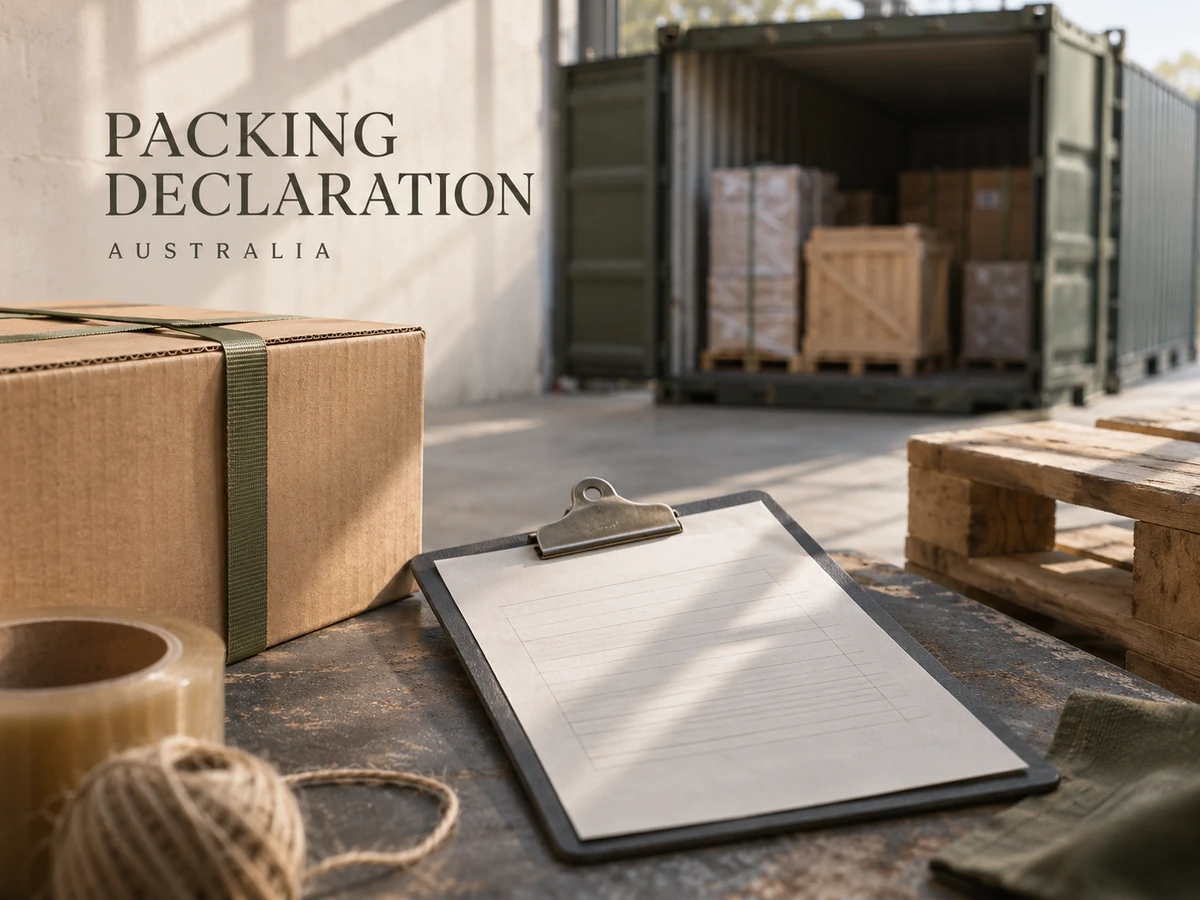
Ask the business that packed your goods, or watched them being packed, to issue the packing declaration, then send it to your Australian customs broker for review before the cargo leaves China. Australia’s Department of Agriculture, Fisheries and Forestry (DAFF) uses the declaration to assess the packaging materials in a sea-freight shipment and, for full-container cargo, the cleanliness of the container. When goods are consolidated or repacked in China, the declaration must describe the cartons, pallets and crates as they are finally loaded.
When Do You Need a Packing Declaration for Australia?
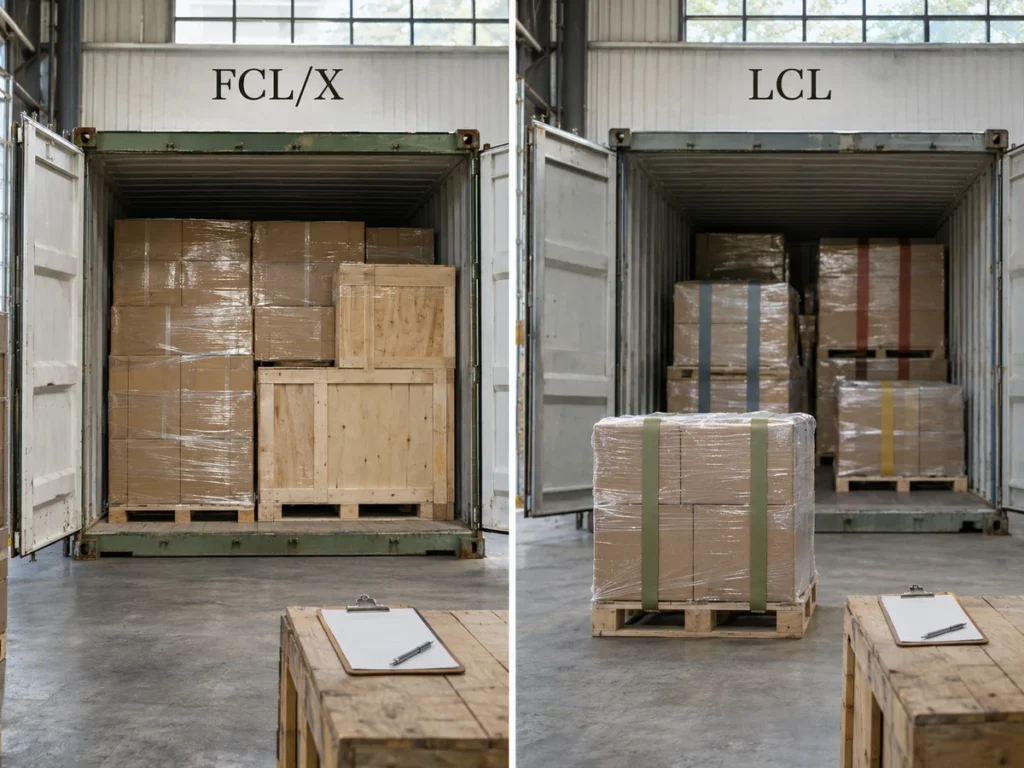
Containerized sea cargo needs a packing declaration, including full-container-load (FCL), multi-supplier full-container (FCX) and less-than-container-load (LCL) consignments. The requirement applies even when the goods are packed only in cartons, because the declaration still has to answer the unacceptable-material question as well as the timber question. The packing list does not replace it, since a packing list records quantities and weights rather than the biosecurity statements DAFF assesses. For cargo that does not move in a standard sea container, ask your broker which non-commodity requirements apply.
Who Can Issue and Sign a Packing Declaration?
The declaration must come from the business that packed the goods into the container, or into the consignment for LCL. DAFF accepts the exporter, the supplier or a third-party packer, and it treats a business that observed the packing as the packer. The rule exists so the issuer has actually seen what it declares. If the declaration is issued from a country other than the one where the goods were packed, a biosecurity officer may ask how that business packed or observed the cargo. The importer collects the declaration with the other sea freight documents, and the broker checks it against DAFF’s documentary requirements.

Which Packing Declaration Should You Use?
Match the declaration to the cargo arrangement and to how often you ship with the same packer. DAFF publishes templates for each type; using them is optional, but the required statements and documentary standards still apply.
| Declaration | What It Covers | Container Cleanliness Statement |
|---|---|---|
| FCL/X | One full container for one importer, including a container filled by several suppliers | Included |
| LCL | Your consignment in a shared container | Left off; DAFF asks that it not appear |
An annual packing declaration can cover repeat consignments for 12 months from its issue date, and it must still be valid when the container is exported to Australia. The importer and exporter names on it link it to each shipment, so recheck it whenever the packer, the packaging materials or the consolidation arrangement changes. It covers only the packing its issuer carried out or observed. An FCX container usually needs a shipment-specific declaration instead, because DAFF requires the container number as the consignment link.
How Do You Complete the Packing Declaration?
Answer every statement from the final export packaging, then endorse the form as the issuing company.
Packaging and Treatment Statements
The form first asks whether unacceptable packaging materials were used. The DAFF templates name straw, peat, hay, chaff and used fruit or vegetable cartons, and DAFF’s fact sheet adds examples such as bark, rice hulls, soil bags, used tires and strawboard. The next question covers solid timber or bamboo used as packaging or dunnage, the material that supports or braces cargo, including pallets, skids and crates. On FCL/X forms, a closing statement confirms that the container is clean and free of soil and animal or plant material.
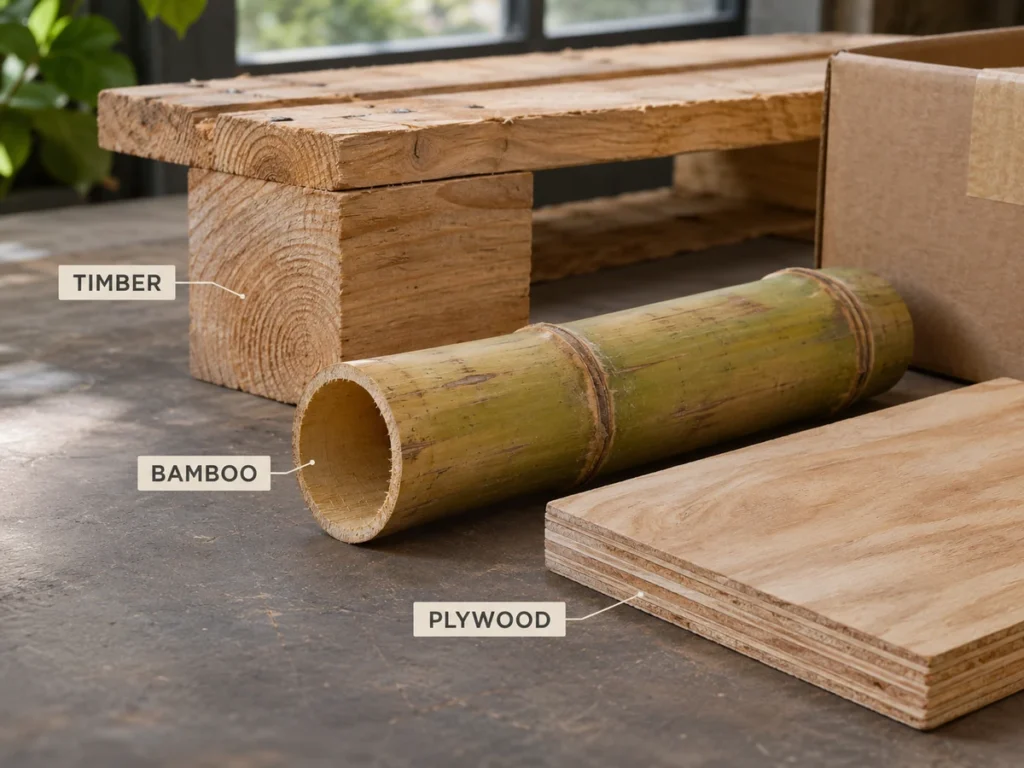
If timber or bamboo is declared, select the treatment option the packaging records support: treated and marked under ISPM 15, the international standard for wood packaging; treated to DAFF requirements, with a treatment certificate attached; or not treated. ISPM 15 applies only to timber, so it cannot support a treatment answer for bamboo. Untreated timber or bamboo packaging needs treatment on arrival in Australia, or it may be re-exported or disposed of at the importer’s expense, so confirm the arrangements with your broker before dispatch.
Letterhead, Reference and Endorsement
These details decide whether the declaration meets DAFF’s documentary requirements:
- The issuing company’s letterhead shows its name and physical address in English characters, or a company stamp or seal carries the same details.
- A consignment-specific reference, such as the container number, appears on every page, with the endorsement on the last page.
- An employee of the issuing company signs after the statements and adds a printed name.
- The issue date shows day, month and year in a format that cannot be misread.
What Should You Check Before Sending the Declaration?
Compare the declaration with the cargo as finally loaded, and send any error back to the business that issued it.
| Check | If It Fails |
|---|---|
| The issuer packed the goods or observed the packing | Obtain the declaration from the business that did |
| Materials added after supplier dispatch are declared | Have the responsible packer correct or reissue the declaration |
| The treatment answer matches the packaging and any certificate | Correct the answer or supply the missing certificate |
| References, company details, endorsement and date are complete | Correct and endorse the change, or reissue the declaration |
Only an employee of the issuing company can amend the declaration, by applying a company stamp or seal beside the change and signing it with a printed name; the original issue date then stands. The issuer can instead replace it with a corrected declaration carrying a new issue date. If no acceptable declaration can be obtained, the consignment can be directed for onshore management in Australia, so ask your broker what inspection or treatment that involves.
Packing Declarations for Consolidated Cargo From China
Check what changes between factory dispatch and warehouse release, because a supplier’s declaration can become incomplete once a warehouse adds pallets or supports. Suppose one factory ships loose cartons, another ships timber crates, and the consolidation warehouse then places the cartons on solid-timber pallets. The final declaration has to cover both the crates and the added pallets. For an FCX container, DAFF accepts a single declaration when one supplier or a third-party consolidator did the packing, provided the container number links it to the consignment.
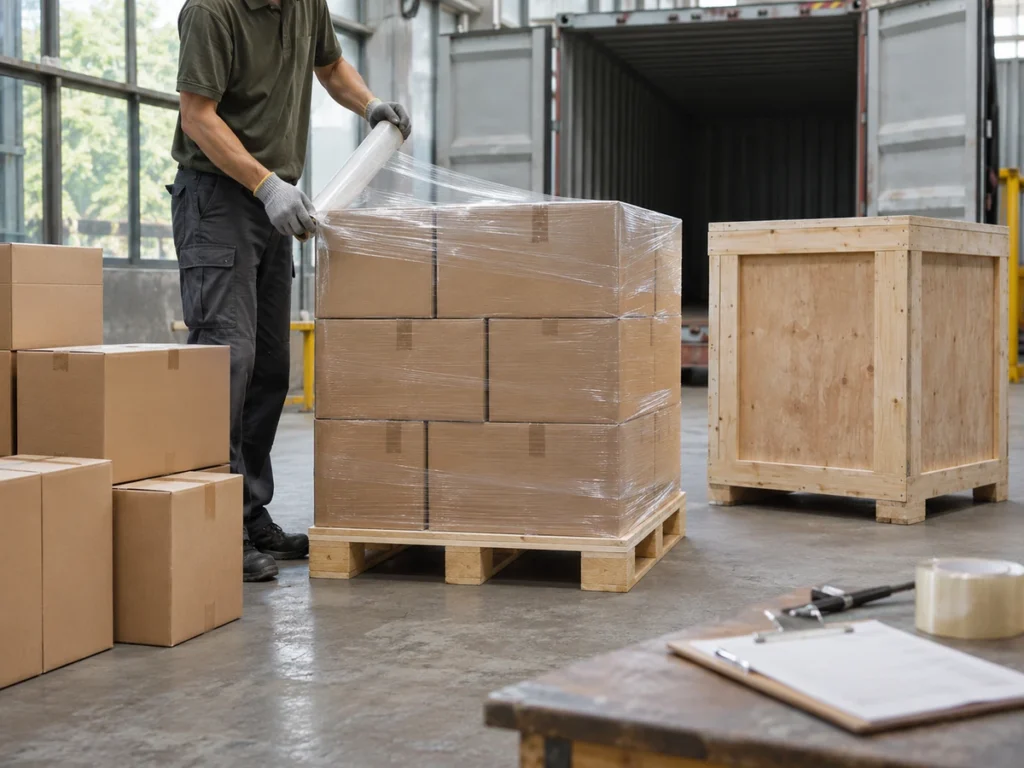
Foresmart collects from suppliers across China and receives their goods by buyer, supplier and purchase-order reference at warehouses in Shenzhen, Yiwu, Shanghai, Ningbo and other cities. Its records of agreed counts, photos, repacking, palletizing and reinforcement show which materials were added after factory dispatch, so you can confirm who should issue the outgoing declaration. For shipping from China to Australia, share your supplier list, cargo-ready dates, packed weights and dimensions and the delivery postcode, and ask for one plan that covers pickup, packing work, sea freight and the document handoff to your broker. Foresmart’s minimum shipment size is 100 kg or 1 cubic meter (CBM).
Frequently Asked Questions
Does Plywood Packaging Count as Timber?
Not when it is sufficiently processed. Plywood, veneer, reconstituted wood and bamboo laminate that meet DAFF’s processing criteria do not need to be declared as timber packaging, but packaging that combines them with solid timber does. Check the whole package, including any solid-timber framing or feet on a plywood crate.
Can a Packing Declaration Be Signed Electronically?
Yes. DAFF accepts handwritten and electronic signatures, including licensed digital signatures, typed names and email signature blocks. The endorsement must still identify the employee by printed name and appear after the statements, so a company stamp that names no individual is not enough.
Can the Packing Declaration Be Issued After Departure?
Yes. DAFF’s policy does not say whether the issue date must fall before or after export; it expects the declaration to be issued and dated once packing has taken place. Review it before departure anyway, while the cargo and the issuer are still easy to reach in China.
Can I Use a Packing Declaration With an Old Department Name?
Yes, provided it meets every other requirement. DAFF continues to accept declarations on older templates or with a previous department name.
Source
- Acceptable documentation templates, Department of Agriculture, Fisheries and Forestry: eligible issuers, declaration types and optional use of the templates.
- Minimum documentary and import declaration requirements policy, Department of Agriculture, Fisheries and Forestry: version 4.2 FAQs on letterhead, dates, multi-page links, amendments, LCL cleanliness statements, FCX container links, issue timing, older department names and onshore management.
- Meeting the Minimum documentary and import declaration requirements policy: Packing declarations, Department of Agriculture, Fisheries and Forestry: unacceptable packaging examples, treatment options, annual declaration validity and electronic signatures.
- Timber and bamboo packaging, Department of Agriculture, Fisheries and Forestry: processed wood that does not need declaring and what happens to untreated packaging on arrival.