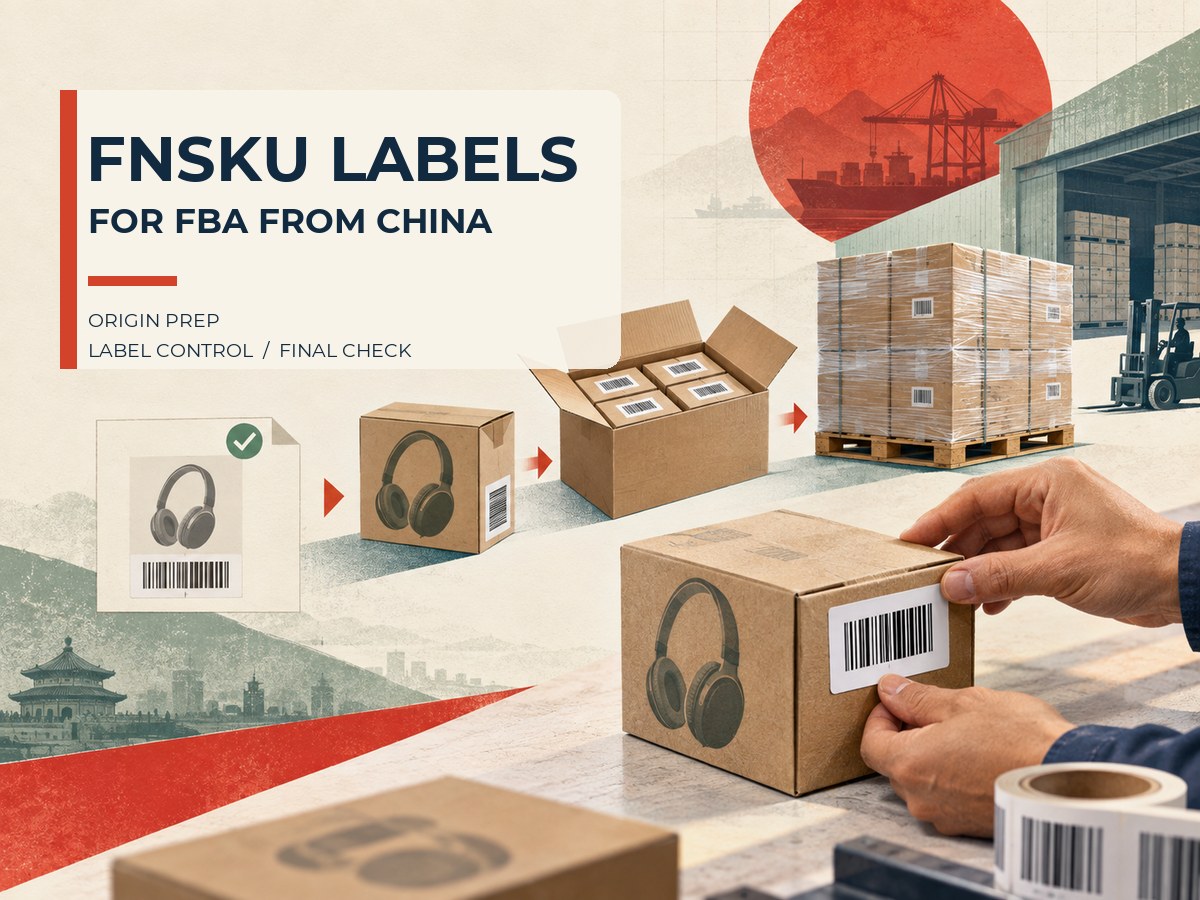
FNSKU labels ensure Amazon fulfillment centers credit incoming inventory to the correct seller and listing. When shipping from China, labeling errors cause receiving delays, commingled stock issues, and costly inbound prep fees. Successful origin prep requires three controls: downloading current barcode files directly from Seller Central, providing your China team with an unambiguous SKU photo map, and verifying scannability before factory dispatch.
What Does an FNSKU Label Do?
An FNSKU (Fulfillment Network Stock Keeping Unit) connects a physical product to a specific seller’s Amazon account. Unlike a universal UPC or EAN, an Amazon FNSKU starting with “X00” prevents inventory commingling. It ensures your goods stay separate from inventory sent by other sellers sharing the same ASIN.
Amazon warehouse scanners read the FNSKU upon arrival to credit your inventory. However, a barcode scan only confirms that a code exists. It cannot catch whether a factory attached a red-variation label to a blue unit. Physical verification at the China origin remains necessary.
Does Your FBA Inventory Need an FNSKU?
Barcode requirements depend on brand registration, product category, and account settings. You should verify the barcode preference in Seller Central for each SKU before authorizing production.
Under Amazon’s barcode policy for inventory shipped on or after March 31, 2026, selling role dictates labeling:
- Resellers without Brand Representative status: You must apply Amazon barcodes (FNSKUs), even if the product carries a valid UPC or EAN.
- Brand owners with verified Brand Representative status: You may use manufacturer barcodes for eligible products under virtual tracking.
- Products lacking a scannable retail barcode: You must apply an Amazon barcode sticker regardless of brand status.
Category rules can override general preferences. Items such as topicals, consumables, and products with expiration dates frequently require Amazon barcodes. Always generate the shipping plan first to confirm the exact barcode requirement assigned to each SKU.
How Is an FNSKU Different From Other FBA Labels?
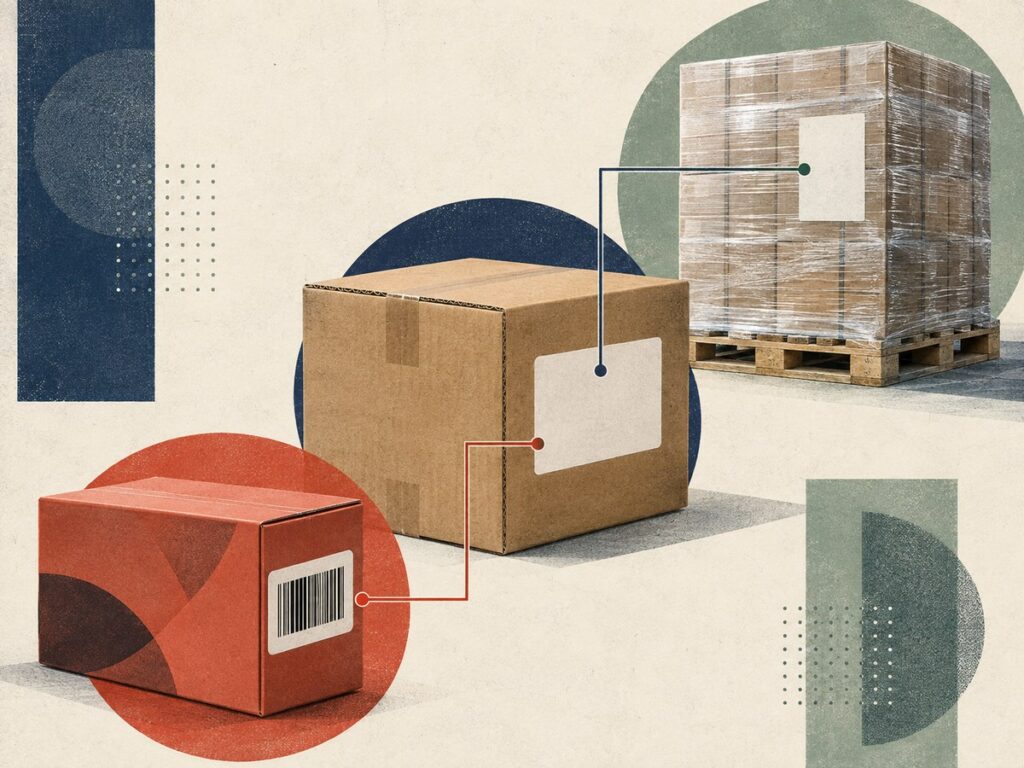
Shipping from China to Amazon FBA involves multiple distinct packaging tiers. Mixing up labels across these tiers leads to rejected cartons or lost inventory.
| Label or Mark | What It Identifies | Where It Applies | Primary Control Document |
|---|---|---|---|
| FNSKU (Amazon Barcode) | Individual sellable unit tied to a seller account | Exterior of each retail unit or polybag | Current Seller Central SKU label file |
| Manufacturer Barcode | Standard retail product identifier (UPC, EAN, ISBN) | Product packaging | Manufacturer packaging artwork |
| FBA Box ID Label | Specific shipping carton and its declared contents | Exterior of each corrugated export carton | Inbound shipment workflow |
| Carrier Shipping Label | Freight movement, routing, and tracking details | Export carton exterior next to the FBA box ID | Carrier or freight forwarder system |
| Pallet Label | Palletized cargo unit for freight delivery | All four vertical sides of stretch-wrapped pallets | Inbound shipment workflow |
| Origin & Compliance Mark | Country of origin and mandatory safety warnings | Product unit, retail box, or outer carton | Customs and trade regulations |
Each label serves a dedicated tier. Outer cartons require international logistics identification, including the export carton shipping mark and the FBA box ID. In contrast, the FNSKU belongs exclusively on the individual retail package inside. When applying FNSKU stickers, ensure they do not obscure country-of-origin marks, suffocation warnings, expiration dates, or batch numbers.
Who Is Responsible for Each FNSKU Step?
Clear operational division between the seller and the China supply chain team prevents costly labeling mistakes.
| Supply Chain Role | Operational Responsibility | Decisions Not Made Locally |
|---|---|---|
| Amazon Seller | Configure barcode type, maintain listings, generate shipment plans, and issue approved PDF files | Reusing older label files or reallocating SKUs across shipments |
| Chinese Factory | Match physical products to the SKU map, apply labels, and submit pre-production photos | Determining barcode eligibility, SKU splits, or destination fulfillment centers |
| China Prep Warehouse | Receive bulk cargo, sort variations, relabel, carton pack, and reconcile piece counts | Modifying listing data or altering FNSKU assignments |
| Freight Forwarder | Verify carton counts, check box labels, manage export customs, and coordinate FBA delivery | Managing Seller Central listings or resolving catalog conflicts |
To avoid confusion on the factory floor, designate a single point of contact on your team to issue label files. Chinese suppliers should never pull label files from informal chat groups or reuse PDFs from prior production runs without written authorization.
What Should the Seller Send Before Labeling Starts?
Providing your China team with a structured prep package eliminates guesswork. Before labeling begins, deliver the following assets:
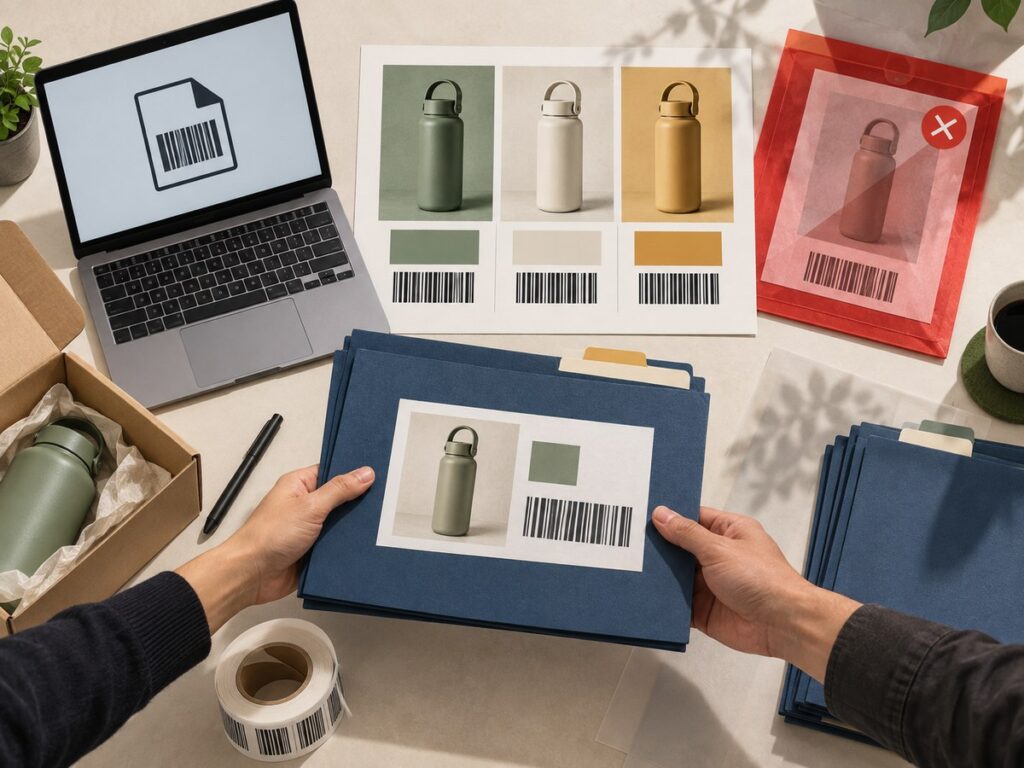
- Current FNSKU PDF: Downloaded directly from Seller Central, organized into individual files per SKU rather than merged sheets.
- Visual SKU Mapping Document: A photo matrix pairing each seller SKU with its corresponding product name, color, size, and packaging preview.
- Packing Specifications: Total unit counts per SKU, designated units per export carton, and gross carton weights.
- Placement Guide: Illustrated diagrams showing exact label placement, orientation, and required distance from package edges.
- Barcode Covering Instructions: Explicit guidance on covering any existing retail barcodes with the FNSKU sticker.
- Sign-Off Protocol: A formal requirement for the factory to submit high-resolution photos of the first labeled unit for seller sign-off.
How Should a Factory or China Warehouse Apply FNSKU Labels?
FNSKU labeling must follow a strict, sequential workflow on the factory floor or at the prep warehouse:
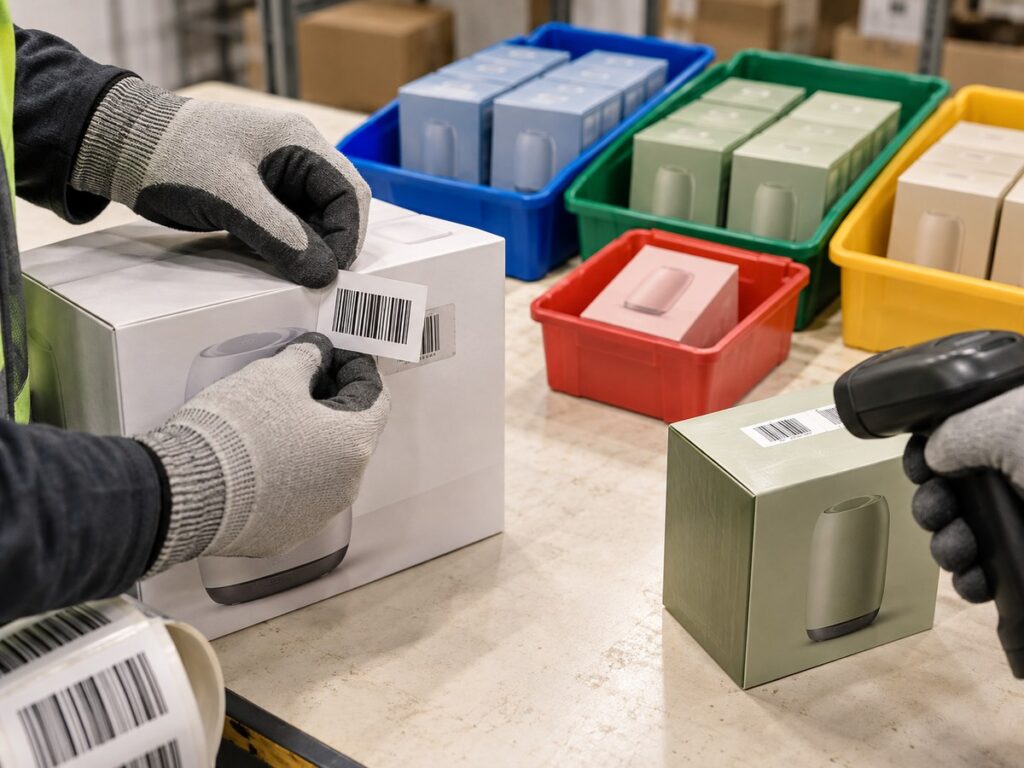
- Isolate variations: Physically separate SKUs on dedicated work tables before unpacking carton batches.
- Select durable label stock: Use thermal transfer printing with permanent adhesive. Inexpensive direct thermal paper often fades or turns black inside hot, humid ocean shipping containers.
- Verify sample scanability: Print a test label and test it with an optical 1D barcode scanner or smartphone barcode app before running bulk prints.
- Cover existing barcodes: Place the FNSKU sticker over any manufacturer UPC or EAN code. Amazon scanners must read only the FNSKU.
- Apply flat on the exterior layer: Place the sticker on a flat, smooth surface of the primary retail box or polybag. Never wrap barcodes around curved corners or over seams.
- Obtain photo sign-off: Send close-up photographs of the labeled test unit and its scannability confirmation to the seller.
- Pack and tally: Count labeled units as they enter export cartons, matching quantities to the packing list before sealing.
Apply labels directly onto the final packaging tier specified in your freight packaging plan. Adding polybags or shrink-wrap after labeling obscures the barcode and forces expensive warehouse repacking.
What Should Be Checked Before Cargo Leaves China?
Before cargo leaves the factory or warehouse for the departure port, conduct a pre-shipment quality audit. The inspection should verify:
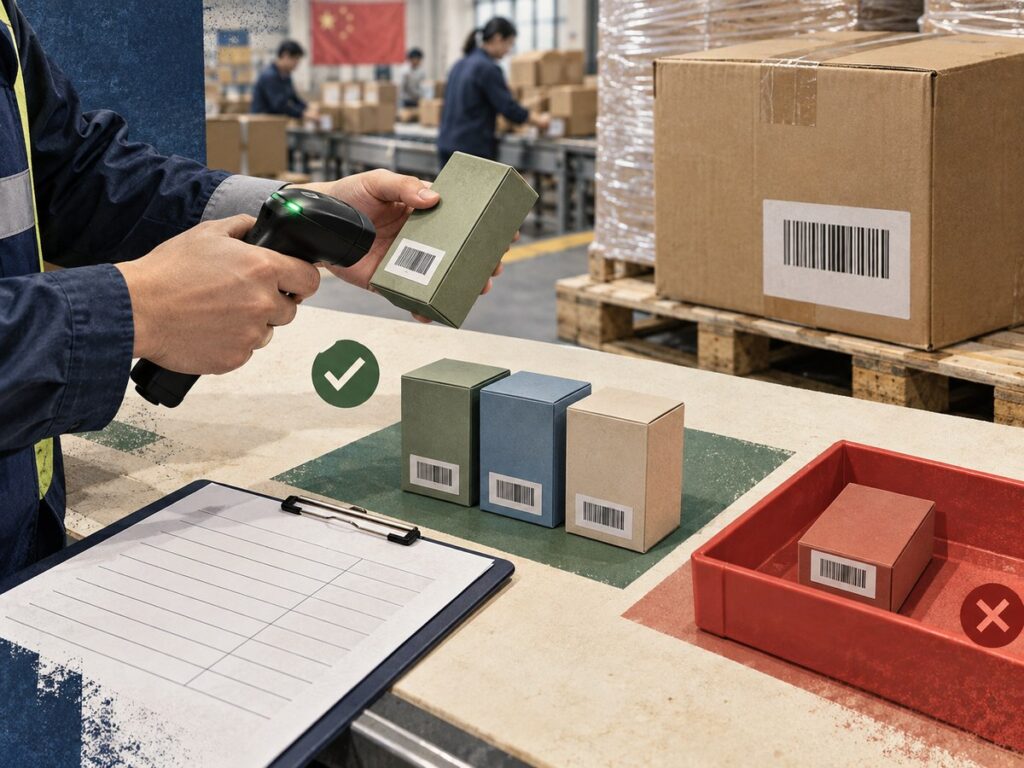
- Barcode scannability: Scanners read the FNSKU instantly, displaying the expected alphanumeric string.
- Legible human-readable text: The SKU description, condition, and product title match the seller’s product catalog.
- Label placement and integrity: Stickers remain flat, firmly affixed, and uncreased after final packing.
- Compliance visibility: FNSKU labels do not conceal “Made in China” country-of-origin marks, safety warnings, or batch codes.
- Carton-level matching: Export cartons carry the correct FBA box ID corresponding to the exact SKUs and quantities packed inside.
Inspectors should pull random carton samples across all variations. If an audit uncovers even one mislabeled unit, hold the entire SKU batch for a 100% check. Correcting labeling errors in China costs a fraction of fixing inventory at an Amazon fulfillment center.
Which FNSKU Errors Cause Rework or Receiving Problems?
Most barcode defects stem from poor file version control or rushed packaging lines. Resolving these issues before export prevents severe fulfillment penalties.
| Inbound Barcode Error | Root Cause at Origin | Corrective Action at China Warehouse |
|---|---|---|
| Obsolete FNSKU printed | Supplier reprinted an outdated PDF | Halt packing, destroy obsolete stickers, and relabel with current files |
| Inverted variation labels | Color or size variations mixed on the packing line | Quarantine the lot, verify physical units against photos, and relabel |
| Uncovered retail UPC/EAN | Label applied next to rather than over original barcode | Apply opaque blocking stickers or reposition the FNSKU over the UPC |
| Unscannable or smudged barcode | Low-resolution print, wrinkled film, or cheap thermal paper | Upgrade to thermal transfer stock, re-verify scanner DPI, and replace labels |
| Mismatched box ID contents | Packing counts changed after generating box labels | Update packing records in Seller Central or reprint matching carton box IDs |
Never dispatch mislabeled inventory assuming Amazon fulfillment centers will correct it smoothly. Inbound barcode defects trigger Amazon unplanned prep service fees, extended receiving delays, and stranded inventory. Catching and resolving errors in China protects your supply chain schedule and preserves Amazon FBA margins.
How Can Foresmart Support FBA Cargo Preparation in China?
Chinese factories often excel at manufacturing but lack familiarity with strict Amazon prep rules. Foresmart bridges this gap through origin warehouse services tailored to Amazon FBA shipping.
Once you supply your approved SKU map and Seller Central label files, Foresmart can handle physical prep. Our warehouse teams receive goods, verify packaging, apply FNSKUs, and palletize to Amazon standards. Consolidating prep and freight under one roof ensures cargo arrives ready for immediate check-in.
To evaluate prep and transport options, share your SKU counts, packaging dimensions, factory locations, and destination warehouse codes. As an experienced globel freight forwarder, Foresmart provides transparent freight forwarding and origin prep solutions.
Frequently Asked Questions
Can a Chinese Supplier Print the FNSKU Directly on the Packaging?
Yes, direct packaging printing works well for private-label products with permanent FNSKU assignments. If yo print barcodes directly on retail boxes or custom polybags, confirm the barcode meets Amazon contrast and sizing standards. Request a printed sample from your factory and verify scannability before authorizing mass production.
Can You Reuse the Same FNSKU for Different Amazon Marketplaces?
No, FNSKUs are generally marketplace-specific. While North American accounts may share identifiers under specific unified programs, European or Asian marketplaces generate unique FNSKUs for identical ASINs. Always verify the barcode assigned in the destination country’s Seller Central before shipping.
What Label Size and Material Should You Use for FNSKU Stickers?
Amazon requires FNSKU labels between 1 x 2 inches and 2 x 3 inches, with black text on a white background. For cargo originating in China, use thermal transfer labels with permanent acrylic adhesive. Inexpensive direct thermal stickers frequently fade or smudge during high-humidity container sea voyages.
Can FNSKU Labeling Be Completed After Cargo Leaves China?
Destination 3PL warehouses can relabel units upon arrival, but origin prep in China remains more cost-effective. Destination rework adds domestic labor costs, handling fees, and trucking stops that delay warehouse check-in. Completing prep in China ensures containers move directly to Amazon fulfillment centers without interruption.