
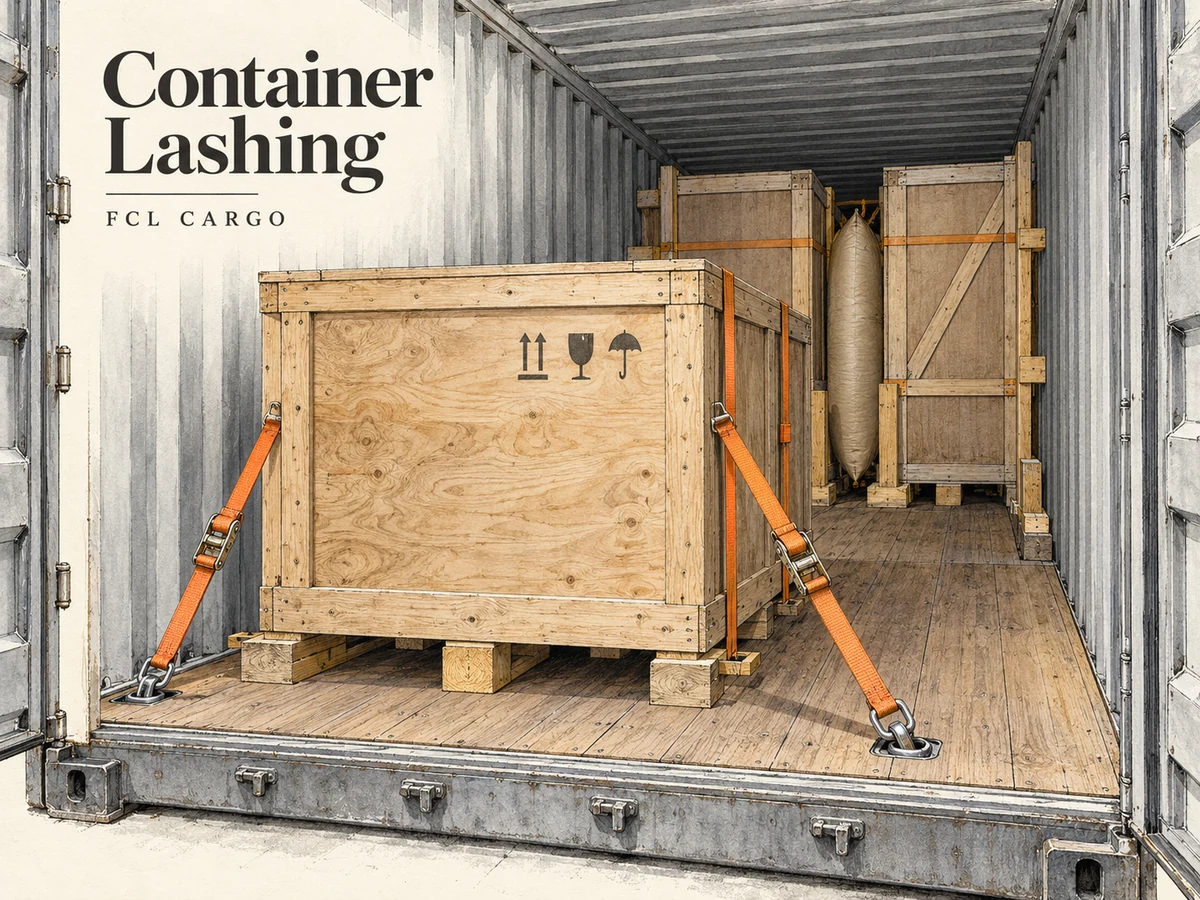
Cargo in a full container load (FCL) is held in place by a combination of lashing, blocking, bracing, and gap fillers chosen for that load. Lashing does its share in one of two ways: it ties cargo to the container’s securing points, or it presses cargo onto the floor so friction resists movement. Together, the arrangement has to keep the load from sliding or tipping on every leg of the trip, including the truck moves at each end, where hard braking pushes cargo forward.
For importers buying from China, two things need agreeing before loading day: a securing method that suits the goods, the packaging, and the actual container, and the party who will carry it out.
How Does Lashing Work Inside a Container?
A lashing passes force from the cargo to the container’s securing points. The web strap or chain is one part of that system; the hooks, buckles, tensioners, and the attachment points at each end are the rest, and each part has to suit the forces involved.
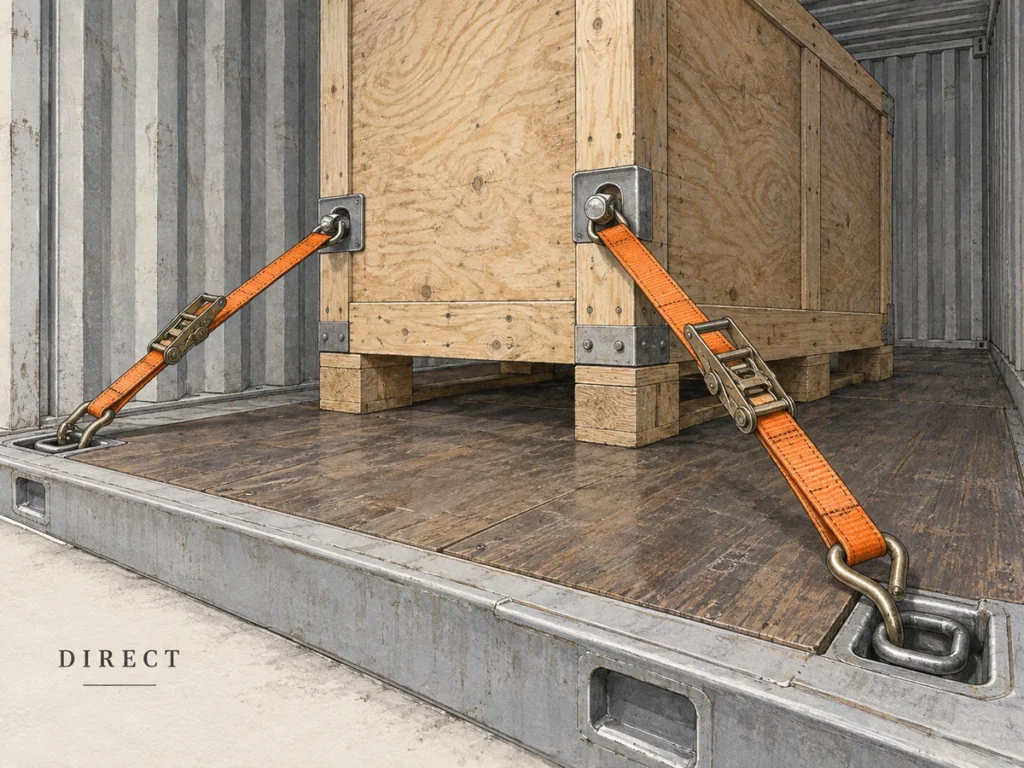
Direct Lashing
Direct lashing ties the cargo to securing points so that each lashing holds against movement in a particular direction. How well it works depends on the lashing angles, where the lashings attach, and the capacity of every part in the system. On machinery or a heavy crate, the packer has to find places where the cargo can take that pull. A lifting eye, a handle, or a thin side panel can look like an attachment point; don’t lash to it until someone confirms it can carry the load.
Top-Over Lashing
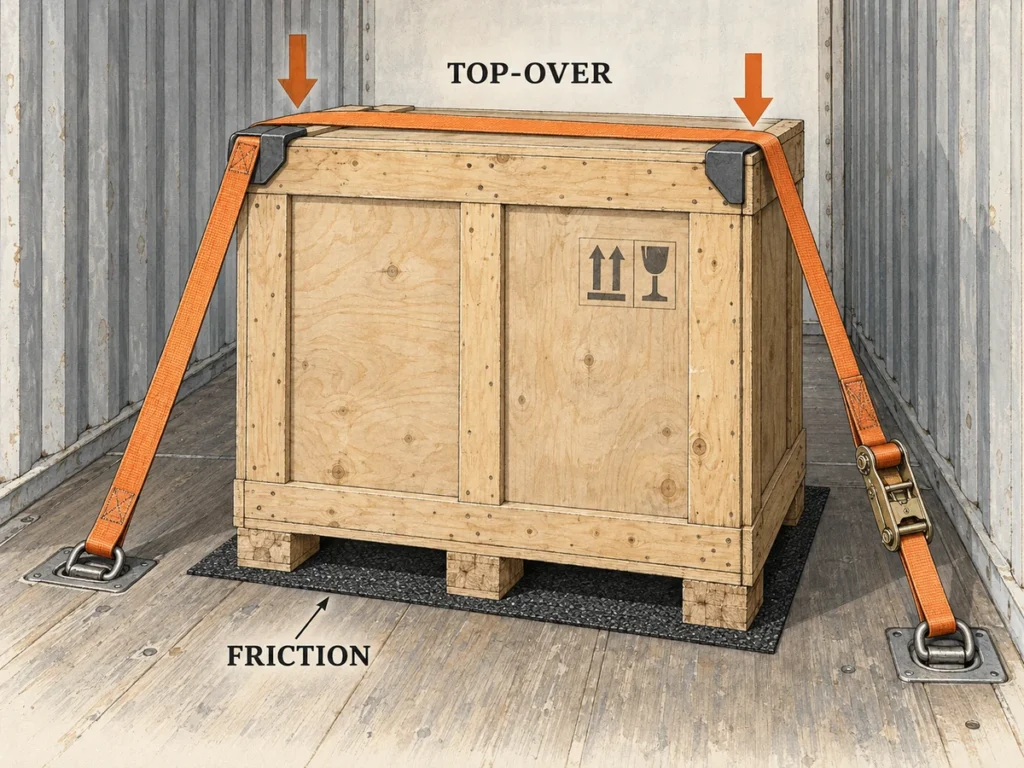
Top-over lashing runs across the top of the load and pulls it down, which increases friction between the cargo and the surface it sits on. The method holds only while the strap keeps its tension and the contact surfaces keep their grip.
That downward pull lands on the packaging. A strap tightened over a weak carton crushes the carton instead of holding the load. Edge protectors spread the pressure and keep straps off sharp corners, but they don’t make a weak package any stronger.
When Does FCL Cargo Need Lashing?
Lashing is needed when the stowage alone won’t stop the cargo from sliding or tipping. Whether the stowage is enough depends on the cargo’s weight, center of gravity, footprint, packaging strength, and the gaps around it, taken together. There’s no standard strap count, either. A rule such as two straps per pallet can’t account for different weights, surfaces, securing points, and transport conditions, so the packer should work the arrangement out from the cargo data.
- Palletized goods need two separate checks: whether the goods are held to the pallet, and whether the pallet is held in the container.
- Crates and equipment need identified load-bearing attachment areas and a check on whether blocking can share the restraint. Tall units need a tipping check as well as a sliding check.
- Floor-loaded cartons need a restraint plan too. Choosing a floor loaded container changes how the goods are handled and stacked, and the securing method still has to be planned on its own.
- Mixed cargo from several suppliers leaves irregular gaps between package sizes. Plan the restraint around the whole load rather than securing each supplier’s goods separately.
Cargo that won’t fit inside an enclosed dry container is a separate planning job. Heavy machinery shipped on a flat rack, for example, has its own split of responsibilities for flat-rack cargo lashing.
How Do Lashing, Blocking, and Dunnage Work Together?
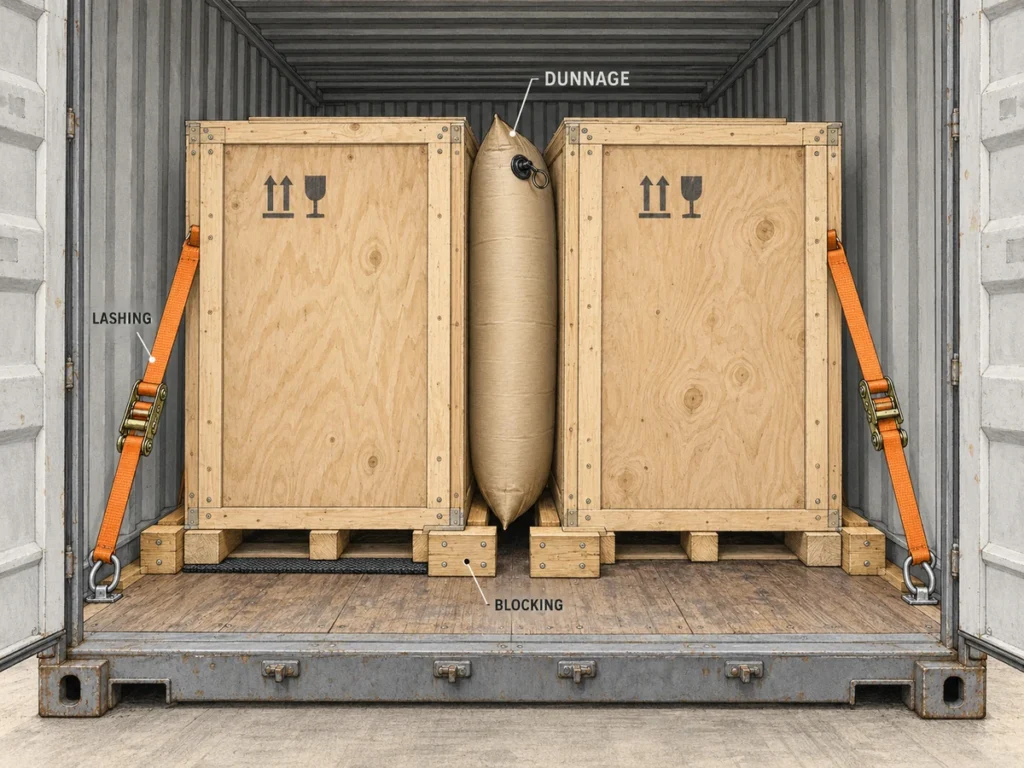
Lashing restrains cargo through tension, while blocking and bracing put a solid support in the way of movement. Dunnage is the material placed around or under cargo to support, separate, or restrain it, such as timber, plywood, or inflatable dunnage bags. One load can combine several of these.
| Method | Main Function | What the Packer Should Check |
|---|---|---|
| Lashing | Holds cargo against movement directly, or raises friction by pulling the load down | System capacity, attachment points, angles, tension, and edge protection |
| Blocking and bracing | Stops movement with fitted supports | Support strength, fit, and where forces enter the container structure |
| Dunnage bags | Fill suitable gaps and transfer pressure between neighboring surfaces | Approved gap size, inflation instructions, contact area, and puncture protection |
| Friction-increasing material | Raises resistance to sliding where surfaces meet | Whether the material suits the surfaces, and the friction the securing plan assumes |
Choose dunnage for the job it has to do. Loose packing that compresses easily won’t work as a structural block. Dunnage bags need solid support on both sides, and a gap that’s too wide, a sharp surface, or weak packaging can rule one out. Inflate each bag to the manufacturer’s instructions rather than judging the pressure by hand.
Container walls can take only a limited load. Bracing has to spread force into parts of the container built to carry it, and a narrow prop pushed against a wall panel concentrates the force instead of spreading it.
What Should You Check Before the Container Is Sealed?
Check the securing plan against the cargo that’s actually there, because supplier estimates made before repacking can describe a different shipment.
Cargo and Packaging
Give the packer measured package dimensions, gross weights, and any center-of-gravity or handling information you have, along with photos that show how each package is built and where it can take a lashing. On a multi-supplier load, keep each supplier’s reference attached to its updated measurements.
Freight packaging has to stand up to both handling and the restraint pressing on it. Ask whether the crate base, pallets, cartons, and internal supports suit the proposed loading and lashing method. Fix a weak base or an unstable stack at the package itself; an outside strap won’t make up for it.
Lashing Points and Equipment
Confirm capacity from the container and equipment actually in use. The lowest-rated part of a lashing limits the whole system, which is why a stronger strap can’t make up for a weak attachment point. If no one can tell you the capacity, ask the packer which ratings the complete arrangement relies on.
- Check the condition and rated capacity of every securing point used.
- Inspect straps, hooks, buckles, and tensioners for damage, and confirm they’re compatible with each other.
- Work from the securing rating. Breaking strength is a higher limit and shouldn’t be treated as the allowable working load.
- Protect lashings where they cross sharp edges or abrasive surfaces.
- Have the packer confirm that the arrangement covers every direction the cargo could move.
Completed Load and Records
Look over the finished restraint before the doors close: blocking fitted, lashings placed as planned, dunnage bags still supported. Give the door end extra attention, because anything loose there can fall out when the container is opened at destination.
Ask for dated loading photos, the final package tally, the container and seal numbers, and the packer’s completion record. Photos show what was visible on loading day. They can’t prove the strength of a hidden attachment, and they don’t replace an assessment of the securing method.
Pass the restraint details to the receiving team as well. A timber barrier or a tensioned strap should come off in a planned order, because cargo can shift the moment its restraint is released.

Who Arranges the Securing Work?
Get two names in writing: the party responsible for the securing plan, and the party doing the loading and lashing. Depending on the agreed shipment scope, either one could be the supplier, the packing warehouse, or an appointed contractor.
Pin down the handoff with four questions:
- Who supplies the final cargo measurements and handling information?
- Who selects and checks the securing arrangement, and which guidance does it follow, such as the IMO/ILO/UNECE CTU Code?
- Who provides the materials, equipment, and labor?
- Which completion records or shipment-specific inspections are included?
Ask for these items to appear in the quote separately from the ocean freight. A booking confirmation, or a price marked “shipping included,” doesn’t tell you who will secure the cargo. If the packing or cargo details change later, send the update to the packer before loading and revise the securing plan and the quoted preparation scope together.
What Cargo Preparation Can Be Arranged in China Before Loading?
Receiving counts, photos, labeling, repacking, and palletizing can be arranged at a consolidation warehouse in China before the container is loaded, within the agreed scope. Through multi-supplier consolidation, Foresmart brings every supplier’s arrivals into one receiving and shipping plan and books the FCL ocean freight. The receiving records and final measurements from that warehouse are what the packer should plan the load from.
In one consolidation case for a Canadian buyer, a care-facility operator’s orders from several Chinese suppliers were combined at one warehouse and shipped to Canada in a single container.
Request a shipment-specific quote with your packing list, package dimensions and weights, cargo photos, pickup locations, destination, and ready dates, and ask for it to state who handles packing and securing.
Frequently Asked Questions
Does FCL Mean the Container Must Be Completely Full?
No. Full-container-load (FCL) shipping books the whole container for one shipment, however much of it the goods fill. Empty space still matters, because cargo can shift into it, so the packer has to block, brace, or fill the gaps. Booking FCL doesn’t tell you how many lashings the load needs.
Can Shrink Wrap Replace Lashing for Palletized Cargo?
Not by itself. Wrap can hold goods to the pallet when its strength suits the load, but the pallet still has to be restrained inside the container. Check the wrap, the stability of the stack, and the pallet’s restraint as separate questions before deciding whether the load needs additional lashing.
Can Container Lashing Straps Be Reused?
It depends on the system. Some web lashings are built for repeated use, while others use one-way components meant for a single trip. Follow the manufacturer’s instructions, inspect reusable equipment before every use, and don’t treat a used strap as reusable just because it looks intact.